

For many small and mid-sized businesses, inventory management issues don’t start in the warehouse. They start in the systems that run the business. Purchasing lives in one tool, receiving lives in another, inventory might live in a different app entirely and accounting keeps its own separate view of what was ordered and received. And somewhere, there’s a spreadsheet trying to tie it all together.
Individually, each tool works fine, but when you put them together without integration, you get a patchwork of incomplete data. That patchwork is one of the biggest hidden causes of inventory inaccuracy. In today’s supply chain environment where lead times shift, orders change, and customers expect fast fulfillment, fragmented systems are a liability businesses can’t afford.
The Hidden Impact of Fragmented Processes
When purchasing, receiving, inventory, and accounting don’t talk to each other, you end up with gaps. Gaps turn into errors and errors turn into operational headaches. Common symptoms include inventory mismatches between systems, delayed stock updates, manual data entry that introduces errors, a lack of audit trail, and slow or inaccurate financial reconciliation. These are operational problems, but they stem from a systems problem.
Why the Purchase Order Workflow Holds Everything Together
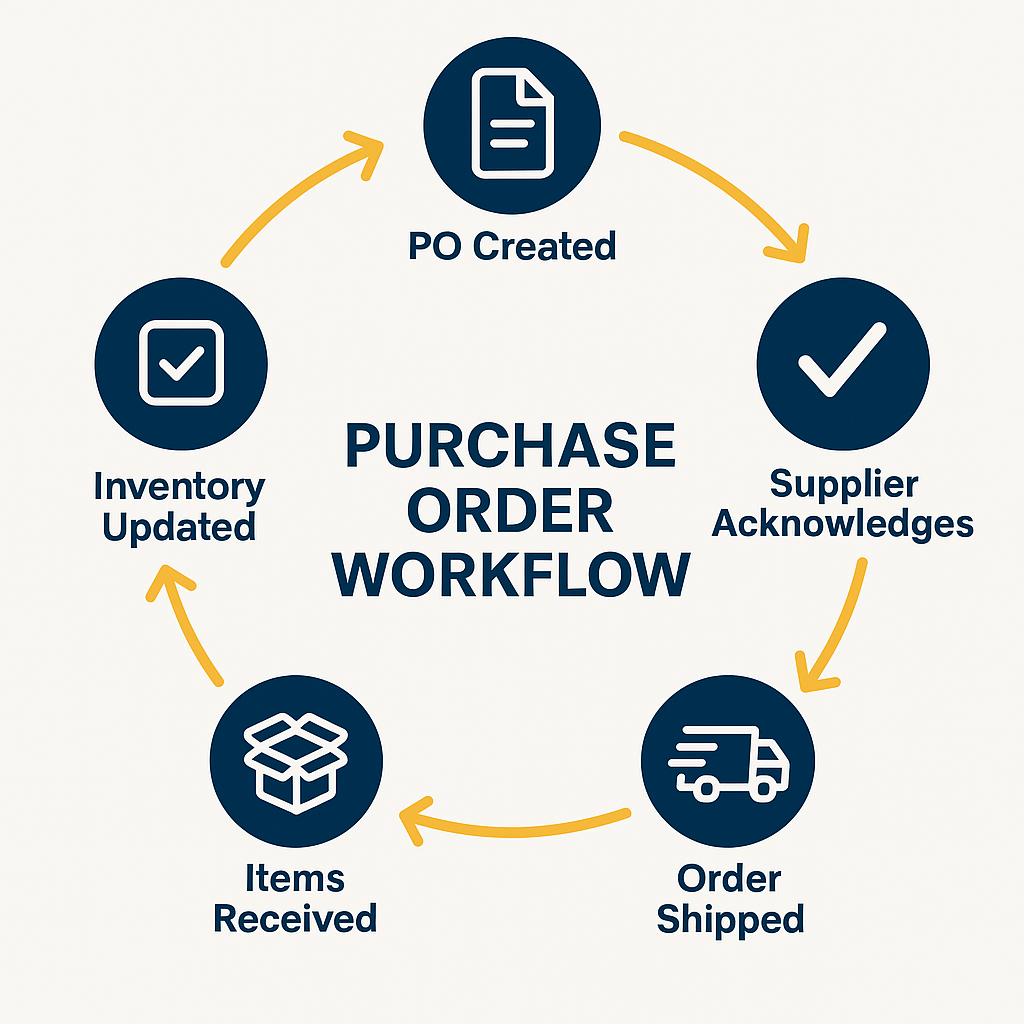
A purchase order isn’t just a document. It’s the connector that links procurement, suppliers, receiving, inventory, and finance. When the purchase order workflow is unified and enforced, every movement of product follows a predictable, traceable path.
- A PO is created and approved.
- The supplier acknowledges it and provides expected delivery dates.
- The warehouse receives goods against that PO and inventory updates automatically.
- Accounting matches invoices to the PO and receipt.
This structure prevents informal purchasing and ensures that every item entering the warehouse is accounted for. A healthy PO process creates alignment across the entire business.
Where Most Systems Fall Short
Many businesses try to improve inventory accuracy by updating warehouse processes or switching inventory systems, but they skip the underlying issue that their PO process is disconnected from their inventory system. Even with solid receiving workflows or ERP tools, if the PO system doesn’t integrate, everything downstream becomes unreliable.
How InventoryWorks Solves the Fragmentation Problem
InventoryWorks is built on Salesforce, which means purchasing, receiving, inventory, fulfillment, and workflow automation all live in one platform. It provides a single source of truth for purchasing and inventory so there are no manual syncs or mismatches. Inventory updates automatically when a PO is received. Procurement, warehouse teams, and finance can all work from one connected workflow. Manual double-entry is eliminated, reducing errors and saving time. Business leaders gain better visibility into what’s on order, what’s delayed, what has been received, what’s been paid, and how inventory levels will change in the coming weeks.
The Result: Inventory Accuracy You Can Trust
By connecting the entire purchasing lifecycle, InventoryWorks gives businesses the accuracy and transparency they’ve been missing. Teams work together instead of in silos, data flows seamlessly instead of manually, and inventory accuracy becomes reliable instead of guesswork.
If your business feels stretched across multiple tools or workflows, the simplest path to better inventory management may be a better purchase order workflow managed within a single platform. Want to see how this works in Salesforce using the Small Business Inventory Management app? Learn more at https://www.sfinventoryworks.com!